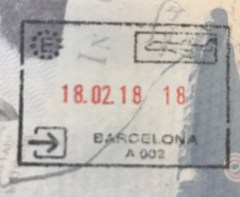
We wanted to move to Spain. We wanted to be able to legally stay past the 90 day tourist visa. We wanted an actual resident card (so cool!). We wanted to embed ourselves in a new language and culture. We wanted to make it challenging and a bit difficult to return to our old ways and the comfort of the US. We wanted an entire ocean between the old and the new. And, the process was surprisingly doable; not easy, but achievable.
I will try to make this as simple as I can because when we started researching, there were words and processes that were so foreign. Bloggers and authors of articles used vocabulary off the cuff, like it was understood that I knew the subject in advance. I didn’t and I was completely ignorant on to how to become an expatriate. And, moving forward, I want to be a helpful resource to others, especially those in the early throes of investigation. If I am too simple, just scroll forward to the bullet points.
Disclaimer! I am not a legal advisor. I always recommend seeking the advice of an attorney or professional company that can assist with any move to another country. I am only sharing my experience and process on how we moved from the US to Spain. Each and every situation is unique, and I will try to explain these as I go along. This process is also strictly for US citizens moving to Spain.
First, what entitles someone to visit or reside in another country? This entitlement is called a VISA. By definition, a VISA is an endorsement issued by an authorized representative of a country and marked in a passport, permitting the passport holder to enter, travel through, or reside in that country for a specified amount of time, for the purpose of tourism, education, employment, etc. (Dictionary.com). Because of an agreement between countries, US citizens can use their Passport as a tourist visa to visit Spain (and European Union) for 90 consecutive days (other entitlements and restrictions apply). But what does one do to stay longer than 90 days? One has to apply for a different visa based on the needs and ability of the individual. There are many distinctive types of Spanish visas, including student, work, and retirement visas. The visa that fit our needs and ability best was a Non-Lucrative Visa (NL Visa)
The Non-Lucrative Visa allows the foreigner to reside in Spain without engaging in any type of lucrative activity. This means that we (the foreigners) cannot work in Spain. As a side note, this was perfectly acceptable to us as we had already worked our fingers to the nub in the US. We were tired, and we had saved money. We planned to take a hiatus from the US and work, receiving an early retirement of sorts, but knowing we would have to make money again in a few years. The funds were and remain limited. The NL Visa was set up for retirees, but no age restriction was placed on this visa. We liberally planned to stay in Spain 3-5 years.
It was September 2017 and our residence was Georgia. Our loose plan was to make the ultimate and final move in February 2018. This gave us 5 months to get everything in order, make all the appointments, allow for mistakes and travel, and give me a few months to tamper my anxiety. We were all moving to Spain: my husband, DJ, my daughter, Josephine, myself, and my dog, Blue Jeans. It was a big list and a ton of paperwork. My advice is start working on the paperwork as soon as possible.
There are several Spanish consulates in the US. Based on your last residence, a consulate is assigned to you. Because our residence was in Georgia, our assigned consulate was based in Miami, Florida. I have lightly perused each consulate’s website and read other blogs on the requirements. I have determined that each consulate has their own requirements, submissions, and process. I will be explaining the process from the Miami consulate with basic information. For exact wording, please refer and follow the requirements of the official Miami consulate website: NL Visa Requirements Miami.
STEP 1: GATHER YOUR PAPERWORK (instructions for a single individual)
- Two National Visa Application forms completed and signed. These forms are in Spanish and I will link a sample form that is filled out.
- Original and Copy.
- Two recent pictures, passport size (white background) glued to the application forms. We used staples to attach our photos, but the rules may have changed since we applied.
- Passport with a validity superior of one year and at least two empty pages. Make sure you sign your passport and add the emergency contact information.
- Original, and Copy of all pages.
- Driver License or State I.D. with current address.
- Original and Copy.
- Original certificate of good conduct (police clearance) issued by the Federal (FBI) or State Government. We applied with the Georgia Bureau of Investigation (GBI). This is a Fingerprint-Based process: GBI – Q&A. Georgia residents visit the GAPS website at Account Setup. Click the tab for Georgia, then click the tab for Applicant Registration, then click the tab for GBI, and then click the tab for Checks for Visa. We had to make an account by filling in the fields and then paying the fees. We then located our nearest facility to take our fingerprints. The entire process took about 10 business days, where we picked up our official background checks from the GBI office in Decatur.
- Original, Copy, Apostilled (see below), and Translated to Spanish (see below).
- Local Health Certificate with letterhead, stamp, and signature of the Doctor. The letter must state the following: “This health certificate verifies that Mr. /Mrs. /Ms (…) does not suffer from any illnesses that could cause serious repercussions to public health according to the specifications of the international sanitary regulation of 2005.”
- Original, Copy, and Translated to Spanish.
- Proof of accommodation in the city where you want to live as follows:
• Notarized invitation letter from a family or friend where he/she assumes responsibility for lodging, or
• Lease, or
• Deed of the property or
• Letter explaining the reason why you have chosen that city in particular. We wrote a 2 page letter detailing our love of Barcelona and our plan to short-term lease with Airbnb or Corporate Apartment upon approval of the visa while we searched for a long term lease solution. We notarized this letter.- Original, Copy, and Translated to Spanish.
- Proof of private health insurance with full coverage in Spain (copy of policy). We applied with Sanitas (www.sanitas.es). There are expatriate requirements for the health insurance. The insurance is for 1 year, it is paid up front, must have a zero deductible and zero copay, and with a clause of repatriation (to return to one’s home country). We were floored when we were quoted 1,600€ for a family of three for an entire year. This number was what we paid for 2 months in the US with an $8,000 deductible and $100 copay. ⇐⇐This deserves an entire blog post. Later.
- Original, Copy, and Translated to Spanish.
- Proof of sufficient financial resources for the period of residency such as bank statements in USA or Spain of the last year, investments (if stocks or partnerships are owned in one or several companies, it must be specified that no funds are derived from direct labor activity in these companies), annuities and any other source of income with a minimum of 2,151.36€ per month. Add 537.84€ per month per spouse and per child. (Generally, 25,812€ needed for an entire year.)
- Original, Copy, and Translated to Spanish.
- Authorization of Residence Application EX01-Form. This form is in Spanish and I will link a sample form that is filled in.
- Original and Copy.
- Authorization of Initial Residence Fee Form 790 Code 052. This form is in Spanish and I will link a sample form that is filled in.
- Original and Copy.
- Visa Fee, payable with MONEY ORDER to the order of “CONSULATE GENERAL OF SPAIN”.
If you are married, you will need your original marriage certificate. If you have children under 18, you will need an original birth certificate. Each person will have all of the above documents for a family visa application packet.
Once you have gathered all your documents, some of the more official paperwork will need an Apostille Certification. Apostilles authenticate the seals and signatures of officials on public documents such as birth certificates, court orders, or any other document issued by a public authority so that they can be recognized in foreign countries that are members of the 1961 Hague Convention Treaty (travel.state.gov). For our family, we had to have both Background Checks, the Marriage Certificate, and our daughter’s Birth Certificate under the Apostille Certification. For Georgia residents, we visited the office in Atlanta: (404)-327-9058 or http://www.gsccca.org.
Now, the packet has to be officially translated to Spanish. Not every document needs translation because the some of the forms are already in Spanish. We simply googled Sworn Official Translators for Spanish and found an attorney in Miami. We emailed the documents that needed translation and overnighted the originals. Remember that the translator also has to translate the Apostille Certification so translation should be your last step before your appointment with the consulate. This is one of the more costly services as translations run $20-$40 per page. The stamped and translated pages will be sent back via overnight to you.
Your application packet should have documents less than 3 months old. Ideally, nothing should be dated more than 60 days to be safe. You will turn in your passport with your application packet so no international travel is allowed while the application is being reviewed. Also, it is important to note that all dates are written DD/MM/YYYY (which makes so much more sense).
Your last step will be to turn in your documents at the consulate. We traveled to Miami a few days in advance because we knew the traffic and weather in the area. We lived in the south for 40 years. We are well prepared for tornadoes, hurricanes, forest fires, major traffic and the sort. We even scouted the consulate building a day prior to our appointment. We are notorious for missing flights and going to wrong addresses (note my anxiety), so I wanted to be well prepared.
UPDATE: It is important to note that the process for the Miami consulate has changed since we made application. The Miami consulate does not take appointments, but is on a first-come, first-served basis. All parties must show in person from Monday to Friday (8:30 AM-1:30 PM), and it is highly suggested to arrive early at the premises.
We had everything. We had a list. We had our money order. We arrived at our appointment on November 15, 2017, without incident. I even put on lipstick for the occasion. Our packets were received and we waited. Despite the Miami consulate webiste requesting originals, the office actually wanted copies. And I had a folder full of copies so we just exchanged some paperwork and then received a proof of receipt. The application was submitted and it took all of 45 minutes. Now, all we had to do was wait…
And we waited until January 2, 2018. My husband got the phone call while we were sitting in a really swanky restaurant in Ponce City Market in Atlanta, Georgia. We were all approved and we needed to come pick up the documents. It only took 45 days to approve us during a busy holiday season. And, now we had 60 days from our approval date of January 2 to actually make the leap. I purchased one-way airline tickets for February 18, 2018. It was time to take on the daunting task of getting my dog approved and flown over.
One step at a time…

 Loosely Lucy
This was a great read during my zen moment! Till next time!
LikeLike